
Ramsey City Directory Collections
Ramsey has a useful historical directory trail, but the verified source is an Anoka County telephone-directory collection rather than a separately confirmed Ramsey printed city-directory series. That distinction matters. A telephone book can place a listed subscriber or business at an address for a particular period, while it cannot establish every person in a household. The Minnesota Historical Society finding aid identifies the Ramsey subsection, its formats, and the gaps that a search should preserve.
| Ramsey collection | Verified years | Repository | How it is accessed |
|---|---|---|---|
| Ramsey telephone-directory subsection | 1979 | Minnesota Historical Society | Print items and yellow-page volumes listed in the finding aid |
| Ramsey telephone directories | 1980-1986 | Minnesota Historical Society | Mixed print, yellow pages, and selected microfiche |
| Ramsey criss-cross trail | 1987-1992 | Minnesota Historical Society | Print and fiche holdings, checked by identifier |
| Later Ramsey telephone listings | 1994-2005 | Minnesota Historical Society | Print, fiche, and selected yellow-page materials |
The finding aid lists no Ramsey subsection item for 1993, and no pre-1979 Ramsey telephone-directory holding was verified. The county-wide collection begins earlier, in 1916, but that is not proof of Ramsey coverage before 1979. Note: a missing entry may reflect a gap, an unlisted number, or an incomplete collection rather than absence from Ramsey.
Ramsey Telephone Directory Run
The telephone collection is arranged around the kind of search being made. Alphabetical white pages provide residential or business listings with telephone and address information. Yellow pages organize business listings. The late-1980s and early-1990s materials offer the strongest verified Ramsey criss-cross trail, yet every volume or fiche item should be checked against its finding-aid number before drawing a conclusion. A surname can be searched in alphabetical order; an address question may require the street-order material where available.
Use the entry as a dated clue. Save the year, the spelling, the address exactly as printed, and whether the source is white pages, yellow pages, print, or fiche. A subscriber may have been a resident, a business, or another responsible party for the telephone account. A directory entry therefore fits best beside a deed, census line, obituary, or newspaper notice rather than standing alone as proof of a whole household.
Ramsey Directory Research Rooms
The Anoka County Historical Society research room adds the local material that a telephone listing cannot supply. Its collections include newspapers on microfilm, census material, naturalization papers, selected church and civil records, obituaries, maps, and ownership plats. The society reports local newspapers as early as 1863 and holds the Anoka County Union from 1865 to 2002. Its full museum database is onsite, and its online collections, begun in 2019, remain incomplete.
The source page for the historical society shows the breadth of those research holdings.
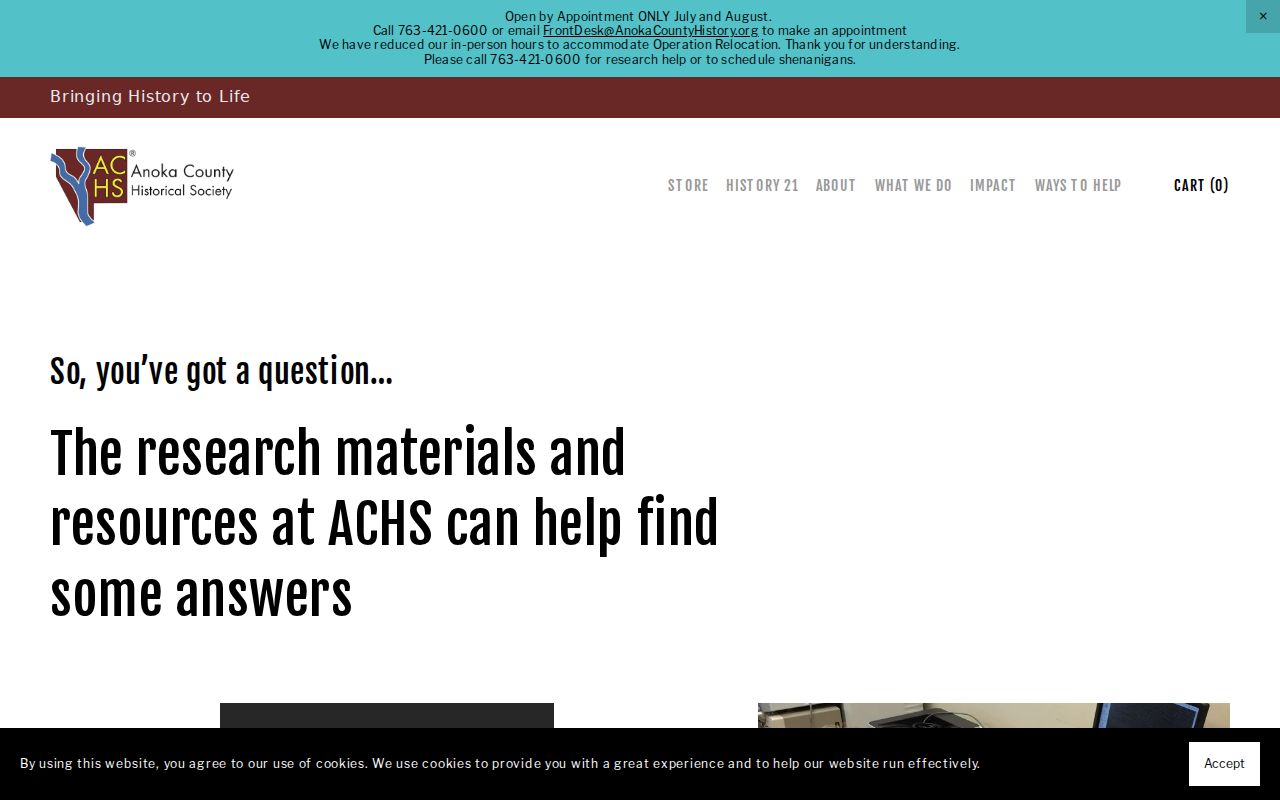
For a remote question, the society accepts an ACHS research request. It offers a brief initial search of about 15 minutes without charge, then lists ongoing research at $20 per hour plus copies and postage. Exact names, dates, and relatives give staff a much better starting point than a broad request for every mention of an address.
Rum River Library can provide local reference access, internet, scanning, and research referrals, but it is in Anoka and is not identified as a Ramsey directory repository. The Minnesota Historical Society's Gale Family Library supplies the deeper directory, newspaper, people-record, and finding-aid route.
Reading Ramsey City Directory Entries
Read a Ramsey city directory result according to the source that produced it. The verified telephone materials describe alphabetical residential and business white-page entries with telephone and address information, plus yellow-page business entries. They do not support adding details that are not printed. Record the precise name form, the listed address, the directory year, and the kind of volume. If a line gives only a subscriber and an address, call it a subscriber listing rather than a full household profile.
| Listed name | Copy the surname, initials, and spelling exactly as the volume prints them. |
|---|---|
| Telephone number | A contact detail tied to that edition, not proof of a present number or address. |
| Address | A dated location clue that should be checked against a parcel, map, or newspaper date. |
| Listing type | Identify whether the entry came from white pages, yellow pages, print, or microfiche. |
| Repository reference | Keep the MNHS finding-aid identifier so the exact volume can be found again. |
- Criss-cross directory
- A directory arranged by address or street order, useful for comparing dated listings at one location when that section is available.
- Subscriber entry
- A listing connected to a telephone account; it does not identify every person who lived at the address.
- Finding aid
- A repository inventory that identifies the particular print volume, reel, or fiche item to request.
Ramsey Directory Search Service
When an onsite trip is not possible, the MNHS City Directory Search Request offers a bounded way to seek a historical listing. The service searches one person or business in one city for up to five years and carries a nonrefundable $5 processing fee. It can be a practical test for a tightly dated question, especially when a newspaper notice or deed already supplies a likely year and name form.
The request service does not turn an incomplete telephone collection into a comprehensive resident list. MNHS notes that city-directory conventions commonly focus on families by the head of household, omit minors, and can list women only when independently entered. Treat a no-result response as a search result with limits, then try a surname variant, a prior surname, the adjacent years, or the archival collections that cover the same period.
The telephone-directory finding aid is the first stop for choosing those years and formats.
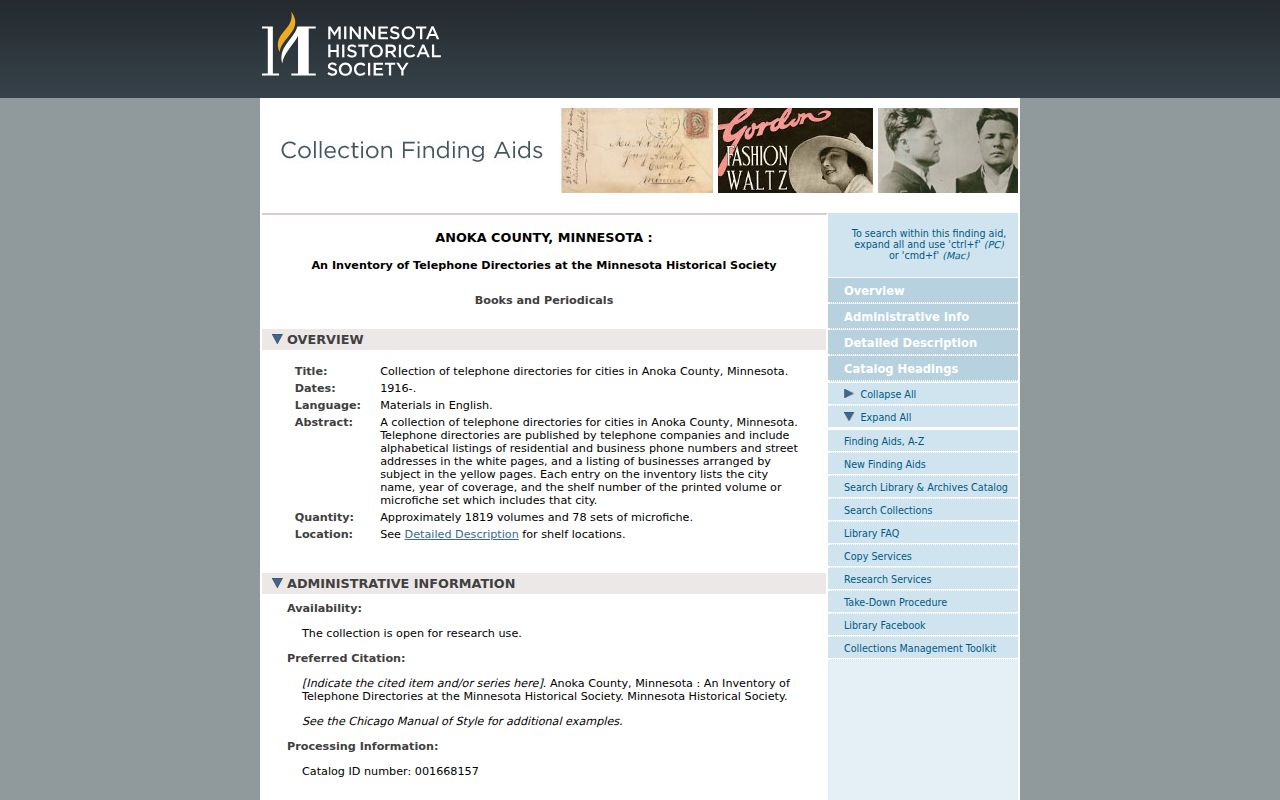
Its Ramsey section makes the mixed print and fiche coverage visible, which helps a researcher ask for a defined item instead of assuming a complete online run.
Tracing Ramsey City Directory Households
A household trail becomes stronger when each source has a narrow job. The telephone directory can supply a dated subscriber and address. The Minnesota state-census finding aid covers 1865 through 1905 on microfilm and can provide a household snapshot from an earlier era. Anoka County Historical Society newspapers, obituaries, plats, and local maps then help explain a move, a name change, or a relationship. Avoid turning any one of those pieces into more than it says.
- Write down the name exactly as it appears in the directory and save the year and repository reference.
- Search nearby directory years, including surname-first, initials, spelling variants, and an unmarried or married surname where relevant.
- Match the address to an 1888, 1914, or 1932 ownership plat, or to current GIS, to retain the legal and geographic context.
- Pair the address period with the appropriate federal census or the Minnesota state-census films for 1865-1905.
- Use the obituary or newspaper index for a date, relatives, funeral notice, property transfer, or probate lead.
A name that disappears may indicate a move, death, a changed spelling, an unlisted number, or a collection gap. The right response is to test another dated source, not to make a certainty claim. For a present-day parcel trail, the Ramsey street directory has the modern address-record approach.
Ramsey Names Before 1974
Historical Ramsey research needs more than the modern city label. Local history describes Watertown, Dover, Ramsey Township, and Ramsey as names that can appear across different periods and records. The city became a city on November 12, 1974. Earlier material may use township, river, railroad, school, or local landmark language instead of a current street number, so those forms belong in the search notes.
Old Ramsey Town Hall supplies a useful civic time marker. It was built in 1892, served school classes through 1945, and was a polling place until 1974. The railroad arrived in 1864, the Great Northern name appears from 1890, and the Northstar station opened in 2012. These are context dates for selecting newspapers, maps, and local terminology, not directory publication dates.
Note: use Watertown, Dover, Ramsey Township, and Ramsey as separate search terms when a historical entry does not appear under the modern city name.
Ramsey Directory Gaps and Evidence
There is no verified complete Ramsey city-directory publishing run, and no source reviewed documents a local courthouse fire or a particular lost decade. Older material can be unindexed online, held under an earlier locality, restricted, or simply never created. MNHS materials remain a mix of print, fiche, microfilm, catalogs, and digital resources. ACHS online collections are also incomplete, while the full museum database is onsite.
Label each conclusion by the record that supports it: listed at an address in a telephone directory, named in an obituary, recorded as a deed party, or enumerated in a census. Those statements answer different questions. If a requested public government record is not online, Minnesota's Data Practices Act access rule supports a prompt written request to the responsible custodian, subject to classification and allowable costs.
Choose the access channel to match the question. The MNHS request service suits a narrow name-and-year search. An onsite visit to the Gale Family Library lets a researcher work from the finding aid and related people-record collections. ACHS is the local route for newspapers, maps, obituary indexes, photographs, and community material, either in its research room or through a defined remote request. When an address trail reaches a parcel record or deed, shift to the Anoka County custodian instead of asking a directory collection to answer a land-record question. Keep the repository, year, format, and source limitation with every note so another researcher can repeat the search.